
Education·1 September 2019
Partnerships with civil society and youth ‘essential’ for a future that leaves no one behind
Partnerships with civil society and youth are essential to achieving the goals of key UN-backed international agreements, such as the 2030 Agenda for Sustainable Development, and the Paris Agreement on climate change, María Fernanda Espinos
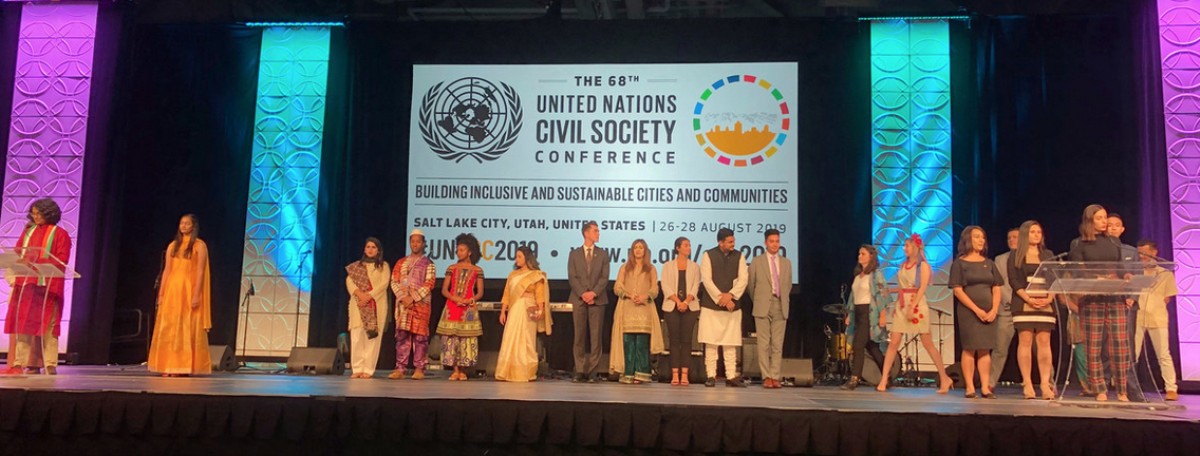
Partnerships with civil society and youth are essential to achieving the goals of key UN-backed international agreements, such as the 2030 Agenda for Sustainable Development, and the Paris Agreement on climate change, María Fernanda Espinosa, the President of the United Nations General Assembly, told delegates at the UN Civil Society Conference on Wednesday.
Ms. Espinosa was speaking at the closing session of the event, which took place between 26 and 28 August in Salt Lake City, Utah, at which representatives from civil society and NGOs resolved to actively contribute to their communities to further the 2030 Agenda.
Despite the many improvements made to people’s lives since the creation of the United Nations 74 years ago, too many still endure insecurity, said Ms. Espinosa. Inequality, and the negative effects of globalization, have led to a reaction against multilateralism, and a rise in racism, xenophobia and violence.
“Every analysis shows that these challenges will not be addressed if we don’t work together. In our increasingly interdependent world, where shocks in one country can affect the lives and livelihoods of people across the globe, it seems clear that we need more cooperation, not less,” she said.
Ms. Espinosa went on to praise the contribution made by civil society in shaping the work of the UN, stretching right back to its earliest days, from the recognition of the equal rights of women and men, to the progress made on children’s rights, indigenous rights, and on the rights of persons with disabilities.
“I encourage you to continue to engage with your governments to ensure we use these opportunities to put us on the right path, and work in your communities on local solutions and initiatives that have the potential to be scaled-up and replicated.”
In our increasingly interdependent world, we need more cooperation, not less. María Fernanda Espinosa, the President of the General Assembly
The Assembly President also urged delegates to take forward the commitments outlined in the Conference outcome document which, she said, reflect a much-needed blend of individual action and responsibility, as well as transformative change at all levels of society.
In the outcome document published on the Conference website, civil society activists underscored the need to understand cities and communities as central to the achievement of all the Sustainable Development Goals (SDGs), and highlighted the importance of inclusivity, peace, family, education, youth, and the empowerment of women and girls.
Originally published by UN News
Keep reading
Education·28 August 2026
Europe's rivers are warning us with our ancestor's handwriting
ON SOURCE: EUROPEAN CORRESPONDENT Drought My first-ever presentation in primary school was about water. Back then I couldn't have known how much scarcer it would get before I even grew up, or that Europe's rivers are drying up and revealing 400-year-old warnings. Europe's rivers are warning us with
EUROPEAN CORRESPONDENT · 1 min read

Education·19 August 2026
The Polycrisis Calls for Polysolutions
ON SOURCE: FORUM FOR THE FUTURE The Polycrisis Calls for Polysolutions Written by Mareyah Bhatti from Forum for the Future. Earlier this month, I had the pleasure of attending the Food Planet Prize event in Båstad, Sweden. It was a great opportunity to celebrate ambitious food system work from acros
FORUM FOR THE FUTURE · 1 min read

Education·6 July 2026
Global push for AI governance amid warnings of ‘catastrophic harm’
Can artificial intelligence benefit all of humanity – safely, fairly and without causing “catastrophic harm”? That is the question at the heart of a major UN summit opening in Geneva on Monday.
UN News - Global perspective Human stories · 4 min read