
Education·10 October 2023
Opinion: UN's impact is hamstrung by scant civil society participation
Ms. María José Andrade Cerda, a member of the female-led Indigenous guard Yuturi Warmi, at the Civil Society Dialogue during the SDG Action Weekend at UNGA 2023. Photo by: Carbon Stories / UN Foundation Global Views United Nations Opinion: UN's impact is hamstrung by scant civil society participatio
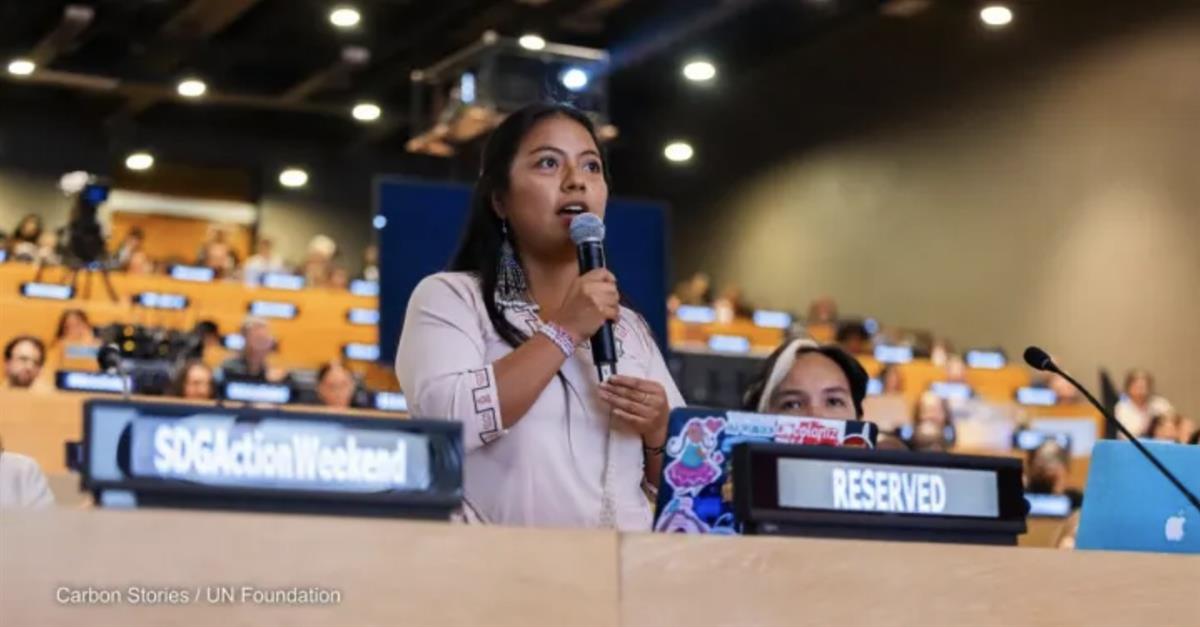
Ms. María José Andrade Cerda, a member of the female-led Indigenous guard Yuturi Warmi, at the Civil Society Dialogue during the SDG Action Weekend at UNGA 2023. Photo by: Carbon Stories / UN Foundation
Opinion: UN's impact is hamstrung by scant civil society participation
By Lysa John, Mandeep Tiwana // 10 October 2023
Let’s not beat around the bush: this year’s United Nations General Assembly was a letdown. The annual September gathering produced very little to solve spreading wars, authoritarianism, nationalist populism, economic inequality, or worsening climate change. Nor did it accelerate progress on the Sustainable Development Goals.
From our view the problem is simple. UNGA doesn’t create enough space for civil society who work on behalf of the world’s underserved people. Instead, UNGA seems to heavily privilege state representation by government officials — many of whom cause the very crises the U.N. must solve and often treat UNGA merely as a platform for propaganda.
We need government representation, but this year’s disappointment shows the U.N. must also focus on access and participation for civil society who work with communities across the world. The first step should be to appoint a U.N. civil society envoy to foster better inclusion of people’s voices in U.N. decision-making. Otherwise, the U.N. risks losing relevance.
“A civil society envoy can help U.N. efforts to break impasses by focusing on the needs of communities and excluded populations.”
Here are five reasons why the U.N. needs a civil society envoy.
1. Without stronger civil society participation, the SDGs will not get back on track
This year’s UNGA was a chance to revitalize the SDGs, which are severely off track at their halfway mark. But the much-anticipated SDG Summit had scant success. The secretary-general’s SDG Stimulus Plan raised few commitments toward its $500 billion goal. The summit’s main outcome was a lackluster political declaration.
Underlying this failure is the fact that the SDGs need more robust civil society engagement. Stronger civil society involvement would drive public policy innovation, promote effective service delivery that leaves no one behind, as well as ensure transparency, accountability, and citizen participation. However, data from CIVICUS Monitor shows that 85% of people live in countries where civic space is under serious attack, while a full 40 states intimidate or retaliate against people who cooperate with the U.N.
With so many governments targeting civil society, reform-minded U.N. officials must lead the way to turn the SDGs around by establishing a civil society envoy who can help catalyze partnerships between the U.N., civil society, and governments.
2. Civil society can rebalance narratives undermining the rules-based international order
U.N.-style multilateralism is at a breaking point. But instead of championing peace and progress to solve compounding global crises, at this year's UNGA we saw many heads of state and government ministers spreading propaganda and unabashedly pursuing their self-interest.
Reviving the spirit of multilateralism enshrined in the U.N. charter and international agreements requires painstaking work. But it can start with giving civil society more space to pull the conversation toward issues that matter to the world’s people, not the privileged. In particular, a civil society envoy can help U.N. efforts to break impasses by focusing on the needs of communities and excluded populations.
3. A civil society envoy can help overcome UN restrictions on citizen participation
This September, 42 heads of government, 88 heads of state, and over 650 ministers plus their entourages strode into the U.N. headquarters during UNGA’s high-level week. At the same time, as it does every year, the U.N. suspended annual and temporary passes for all accredited NGOs — effectively barring most civil society delegates from decision-making spaces. In fact, the only way civil society representatives could enter the U.N. building was by finagling hard-to-obtain special tickets for side events.
It’s a humiliating annual ritual, but all year round, civil society representatives complain about asymmetrical access to the U.N.’s sprawling infrastructure, which is itself full of inconsistencies. We need an envoy to break these blockages and streamline access.
4. A civil society envoy can ensure equitable representation
The few civil society organizations that do enjoy access to UNGA heavily skew toward groups based in the global north who can invest in staff in New York, or easily travel to the U.S. We thus need an envoy who can lead U.N. outreach to communities and organizations in less represented regions to ensure more diverse and equitable participation in the U.N’s decision-making spaces.
An envoy can also drive best practices on civil society engagement and representation across U.N., forums, agencies, and offices, as well as for civil society focal points recommended by U.N. Secretary-General António Guterres in Our Common Agenda.
5. A civil society envoy is possible
Getting anything done at the U.N. requires adhering to what is politically feasible. Thankfully, a civil society envoy is within reach.
Fifty-two states have already signed on to the Unmute Civil Society initiative calling for a civil society envoy. And in opening remarks before September’s SDG summit, Guterres was emphatic in support for civil society in his list of groups necessary for achieving the SDGs. There's also precedent, with recent successful appointments of a youth envoy and tech envoy.
With that in mind, it's time for the U.N. to act on this momentum with the help of supportive states to appoint a civil society envoy. Otherwise, expect another UNGA letdown in 2024.
The views in this opinion piece do not necessarily reflect Devex's editorial views.
About the authors

Lysa John
Lysa John is the secretary general of CIVICUS and lives in South Africa. She has championed human rights and international mobilization for two decades. She worked as head of outreach for the U.N. high-level panel that drafted the blueprint for the Sustainable Development Goals and as global campaigns director at Save the Children.

Mandeep Tiwana
Mandeep Tiwana is the chief officer for evidence and engagement at CIVICUS and the organization's representative to the U.N. A human rights lawyer by training, Tiwana specializes in legislation relating to the core civil society freedoms of expression, association, and peaceful assembly. He is passionate about improving civil society’s participation in decision making and has written extensively on the intersection between civil society, sustainable development, and international affairs.
SOURCE: DEVEX
Keep reading
Education·28 August 2026
Europe's rivers are warning us with our ancestor's handwriting
ON SOURCE: EUROPEAN CORRESPONDENT Drought My first-ever presentation in primary school was about water. Back then I couldn't have known how much scarcer it would get before I even grew up, or that Europe's rivers are drying up and revealing 400-year-old warnings. Europe's rivers are warning us with
EUROPEAN CORRESPONDENT · 1 min read

Education·19 August 2026
The Polycrisis Calls for Polysolutions
ON SOURCE: FORUM FOR THE FUTURE The Polycrisis Calls for Polysolutions Written by Mareyah Bhatti from Forum for the Future. Earlier this month, I had the pleasure of attending the Food Planet Prize event in Båstad, Sweden. It was a great opportunity to celebrate ambitious food system work from acros
FORUM FOR THE FUTURE · 1 min read

Education·6 July 2026
Global push for AI governance amid warnings of ‘catastrophic harm’
Can artificial intelligence benefit all of humanity – safely, fairly and without causing “catastrophic harm”? That is the question at the heart of a major UN summit opening in Geneva on Monday.
UN News - Global perspective Human stories · 4 min read