
Climate·7 August 2026
Preserving Indigenous Wisdom Requires Protecting Forests
By Sophie Grouwels, Forestry Officer, Forest and Farm Facility, FAO
ON SOURCE: SDG KNOWLEDGE HUB
5 August 2026
Preserving Indigenous Wisdom Requires Protecting Forests
STORY HIGHLIGHTS
International Day of the World’s Indigenous Peoples is celebrated on 9 August.
This year’s theme is ‘Honoring Indigenous Midwives: Safeguarding Life and Well-being’.
The lesson for development actors, donors, and governments is that to truly celebrate Indigenous healers, we must recognize their living knowledge as firmly rooted in forests and safeguard those ecosystems.
By Sophie Grouwels, Forestry Officer, Forest and Farm Facility, FAO
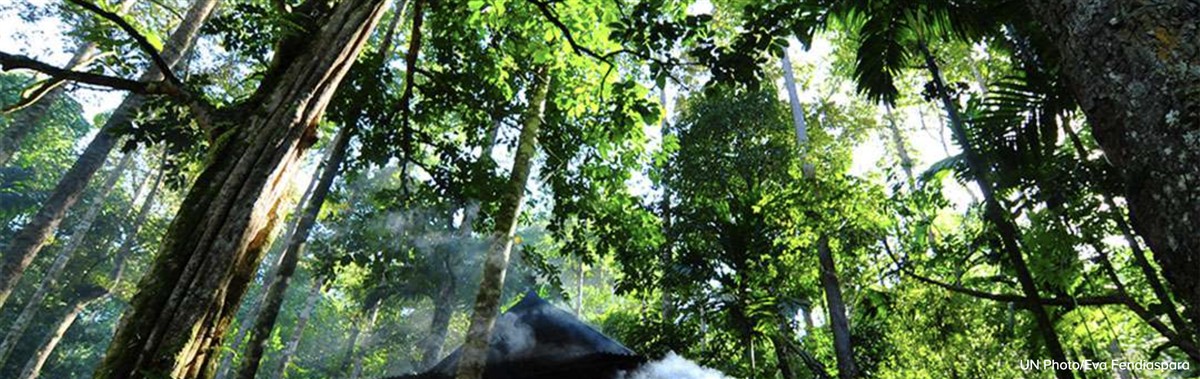
At the heart of many Indigenous communities is a deep understanding of the natural world. Passed down through generations, this knowledge reinforces cultural identity, supports community well-being, and helps sustain forest ecosystems.
Yet with forests under pressure, Indigenous knowledge, traditions, and medicine are at risk of being lost. It is time to change this by celebrating Indigenous knowledge holders by safeguarding the forests on which they depend.
Indigenous Peoples manage some 28% of the world’s land surface, including some of the most ecologically intact forest areas. They play a critical role in sustaining species and ecosystem diversity across the globe.
These groups have long maintained a close relationship with forests and the plants, animals, and non-wood forest products they provide, including many of the ingredients used in traditional medicine, without exploiting the resources.
Enjoying this article? Make sure you always catch our coverage by subscribing to our SDG Update newsletter.
That relationship has global implications. Nearly 80% of the world’s population relies on traditional medicine, and the conservation of medicinal and aromatic plants is a global environmental and health priority. Forest ecosystems are nature’s pharmacies, providing biologically active compounds for healing. Around 50,000 plant species, many of which grow in forests, have medicinal value.
Protecting Indigenous knowledge and the forests that sustain it contributes to the achievement of the SDGs, particularly SDG 3 (good health and well-being), SDG 15 (life on land), and SDG 1 (no poverty), while supporting the rights and livelihoods of Indigenous Peoples.
But Indigenous Peoples have seen their fundamental rights to the conservation and sustainable use of wildlife – and along with them, biodiversity and traditional wisdom – erode, not least through loss of access to forests and lack of land tenure rights.
In Cameroon, the Baka community has traditionally been dependent on the forest for over 80% of their food, as well as plant and animal resources for material and spiritual purposes, building materials, cooking utensils, tools, firewood, medicine, and more. Yet increasing constraints in accessing the forest have led to degradation of diet quality, and their renowned Traditional Knowledge – of about 500 species of wild or ruderal plants used for medicinal, material, and spiritual purposes – is also disappearing.
Without recognized collective land rights for Indigenous Peoples, deforestation rates and biodiversity loss can be significantly higher. For example, protected areas outside Indigenous territories very often host fewer species of mammals, birds, reptiles, and amphibians than Indigenous territories do.
One project to bolster and conserve Indigenous knowledge is taking shape in The Gambia, where an assembly of traditional healers has organized traditional medicine practitioners under a single umbrella since 2009.
The Forest and Farm Facility (FFF), led by the Food and Agriculture Organization of the UN (FAO) together with AgriCord, the International Institute for Environment and Development (IIED), and the International Union for Conservation of Nature (IUCN), supports this assembly as the apex organization for the country’s traditional medicine practitioners.
But supporting Indigenous and Traditional Knowledge demands doing right by forests that provide the materials sustaining it – in this case, herbs, roots, oils, and other resources on which traditional medicine depends.
That awareness has translated into material form. With FFF support, the head chief of Foni Berefet District and the community of Somita granted the healers’ assembly 1.5 hectares of natural woodland. The land now functions as a botanical garden and gene bank – a living archive of the medicinal trees and plants.
The garden is not for display; it is infrastructure for continuity, ensuring that the species at the center of Gambian traditional medicine remain available to the next generation of practitioners.
Among those benefiting from the project are traditional birth companions – practitioners who provide continuous emotional, physical, and cultural support to women through pregnancy, labor, and the postpartum period and who work closely with nutrition advocates in their communities.
Traditional birth companions draw regularly on what grows in the garden. They prepare Gambia tea bush (Lippia chevalieri), which locals call N’ganibakala, as an aromatic tea for relaxation and general well-being. The fruit of the locust bean tree (Parkia biglobosa) provides the iron and protein that support women through pregnancy. The traditional birth companions incorporate moringa leaves and baobab fruit into diets for their nutritional value and turn to hog plum (Ximenia americana) and another bush tea (Lippia multiflora) to ease nausea in pregnancy.
Each of these practices carries knowledge that generations have accumulated – knowledge that lives in the plants themselves, in the language women use to name them, and in the forests that are home to it all.
International Day of the World’s Indigenous Peoples is celebrated on 9 August. This year’s theme is ‘Honoring Indigenous Midwives: Safeguarding Life and Well-being.’ The lesson for development actors, donors, and governments is that to truly celebrate Indigenous healers, we must recognize their living knowledge as firmly rooted in forests and safeguard those ecosystems.
ON SOURCE: SDG KNOWLEDGE HUB
SDGs
-
Goal 1 - No Poverty
-
Goal 3 – Good Health & Well-being
-
Goal 15 - Life on Land
Issues
-
Biodiversity,
-
Ecosystem Approach,
-
Land Tenure and Property Rights,
-
Indigenous & Community Forests,
-
Forests & REDD,
-
Health,
-
Human Rights & Indigenous Peoples,
-
Land,
-
Poverty Eradication,
-
Sustainable Development
Actors
-
FAO,
-
UN Programme, Agency or Fund
Regions
-
Africa,
-
West Africa
Originally published by SDG KNOWLEDGE HUB
Keep reading
Climate·3 September 2026
Why the UNEP 1.5°C overshoot report must be an urgent call to action on climate change
As Greenpeace International explains in its policy briefing, a just transition is more than simply swapping coal, oil and gas for renewables. It is an opportunity to transform energy, transport, industrial and other systems so they are more secure and affordable, reduce inequality, protect ecosystems and shift power from elites and multi-billion-dollar corporations to people.
GREENPEACE · 8 min read
Climate·30 July 2026
Global Commons Alliance: Systems Change Explained
What does systems change actually mean? Watch the fourth video in our global commons e xplainer series , to find out what systems change means, why it’s urgent, and how it actually happens in practice.
GLOBAL COMMONS ALLIANCE · 1 min read
Climate·28 July 2026
The Court Has Spoken. So Has the Assembly. What’s Next?
ON SOURCE: SDG KNOWLEDGE HUB The Court Has Spoken. So Has the Assembly. What’s Next? by Aditi Shetye , Mariana Campos , and Jule Schnakenberg , Global Secretariat, World’s Youth for Climate Justice STORY HIGHLIGHTS The plenary debate on…
SDG KNOWLEDGE HUB · 11 min read